|
| In the 16th century Jewish cemetery on via Wiel, Padova. Photo: Gadi Luzzatto Voghera |
On a stiflingly hot day a couple weeks ago, I spent an afternoon in Padova (Padua), Italy, visiting some of the centuries-old Jewish heritage sites in the city -- they are being developed now as both a resource for
local people and as an attractive itinerary for tourists and other
visitors.
The sites I visited included the new
Museo della Padova Ebraica (Museum of Jewish Padova) which opened in June.
As I wrote on the Jewish Heritage Europe web site ahead of the opening, it is housed in the former “German,” synagogue, Sinagoga Tedesca, used by the
Ashkenazic community, which was inaugurated in 1525 in the heart of the
Jewish quarter, or ghetto, in the city’s historic center. (Note -- part of this post is a repost of my article on Jewish Heritage Europe.)
The
synagogue, on via delle Piazze, was severely damaged during World War II when it was torched
by local Fascists, and it stood derelict until it was completely rebuilt
in 1998 (the ark was transferred to Tel Aviv in 1956). The museum exhibition includes before and after photos.
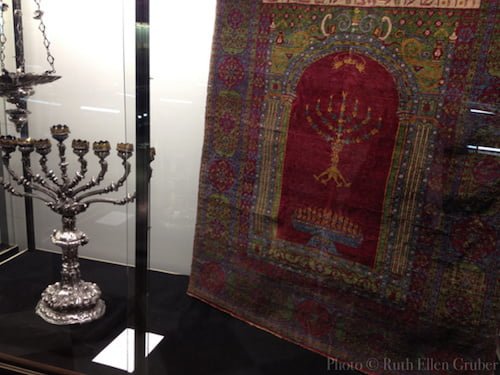
The exhibit includes items from the Jewish
community’s extensive collection of Judaica objects from past centuries
to the present. Among them are a very rare Mameluk parochet from Egypt
dating back to the 15th or 16th century.
There is also an 18th century Megillah of Esther, a 16th century
Torah scroll, exceptional silver torah ornaments, and several ketubot. A backlit photographic reproduction of the Ark occupies the space where the Ark once stood — the ark now being in Tel Aviv.
 |
| Add caption |
Two
films are included in the exhibition. One is a general introduction to
the history of the community. The other — projected on the walls of the
sanctuary where the exhibit is located — tells the story of Padova Jews
through the life stories of several prominent members of the community
over the past five centuries or so, portrayed by actors. I was somewhat dismayed that this film does not include reference to any women in Padova Jewish history....perhaps there were no famous women, but it was the women who kept the community alive, and I believe that their role must also be highlighted, even if it simply means through exhibits dealing with food and marriage customs.....
Other sites I visited included the 16th century
Italian rite synagogue,
which is still used by the small local Jewish
community, and the Jewish cemetery on via Wiel — dating from the 16th
century and the oldest of the five Jewish cemeteries in the city. (You can download an article about these cemeteries
HERE.)
 |
| Bimah in the Italian rite synagogue. Photo © Ruth Ellen Gruber |
The sanctuary of the Italian synagogue is a small, rather long and
narrow space, with an elaborately carved Ark and a delicate wooden Bimah
positioned to face each other from the middle of the long sides of the
room. The Bimah is believed to have been carved from the wood of a
single tree that fell in the botanical gardens.
 |
| Ark in the Italian rite synagogue in Padova. Photo © Ruth Ellen Gruber |
The Jewish cemetery behind a high brick wall in via Wiel, in central
Padova near the Old Town and of ghetto, has been restored and is
beautifully maintained by the Jewish community. Opened in 1529, with
more than 90 16th century tombs, it is the oldest surviving Jewish
cemetery in Padova and one of five Jewish cemeteries that remain in the
city. (Fragments from two 15th century gravestones from a cemetery
destroyed in 1509 are displayed in the city museum).
 |
Jewish cemetery on via Wiel, Padova, founded in 1529
|
The most famous people buried there are Me’ir Katzenellenbogen, or
Maharam, a renowned Ashkenazic rabbi who died in 1565, and his son,
Samuel Judah, who succeeded him and died in 1597.
Mainly because of them, Padova is believed to be the only place in
Italy where devout followers make pilgrimages to the tombs of their
masters. Indeed, Jewish community leaders say that these pilgrims often
do not contact the Jewish community to obtain the key to the cemetery,
but climb over the wall to pray, leave kvittlach (written messages) and
light candles.
Katzenellenbogen gravestones are (rather charmingly) marked by the crest of a crouching Cat (“Katze” in German).
 |
| Add caption |
 |
| Add caption |
 |
| Add caption |
Another noted personality interred here is
Anselmo
Del Banco (Asher Levi Meshullam) who died in 1532. A powerful banker
(owner of several loan-banks in the Venice area), he was the head of the
Jewish community in Venice and represented the community when in 1516
the authorities decreed that Jews there must live in a ghetto. His gravestone is notable for its fine and unusual carving.
 |
Gravestone of Anselmo Del Banco (Asher Meshullam) d. 1532
|